Category Archives: Martial Arts

Wing Chun Lesson 1


I have recently joined Leung Martial Arts Academy studying Wing Chun Kung Fu. With a personal background in western boxing, Muay Thai, and Brazilian Jiu Jitsu I’ve experienced some culture shock with the transition. While some basic components remain the same, other components have completely thrown me for a loop, such as the stance and hand positioning. I have begun to take notes and record my impressions of the lessons and have decided to share some of my journey with all of you.

First, a bit about the school. Leung Martial Arts, located in downtown Eugene OR, was founded in the 70’s by Sifu David Leung. Sifu Leung was born in Hong Kong and has studied martial arts since he was 9 years old. He is a second generation student of Wing Chun Grandmaster Yip Man (under Master Ho Leung) and a third generation student of Yang style T’ai Chi Ch’uan Master Yang Ch’eng-fu. The academy offers a variety of Wing Chun Kung Fu, Yang Tai Chi, Qi Gong, and Chen style Tai Chi classes.
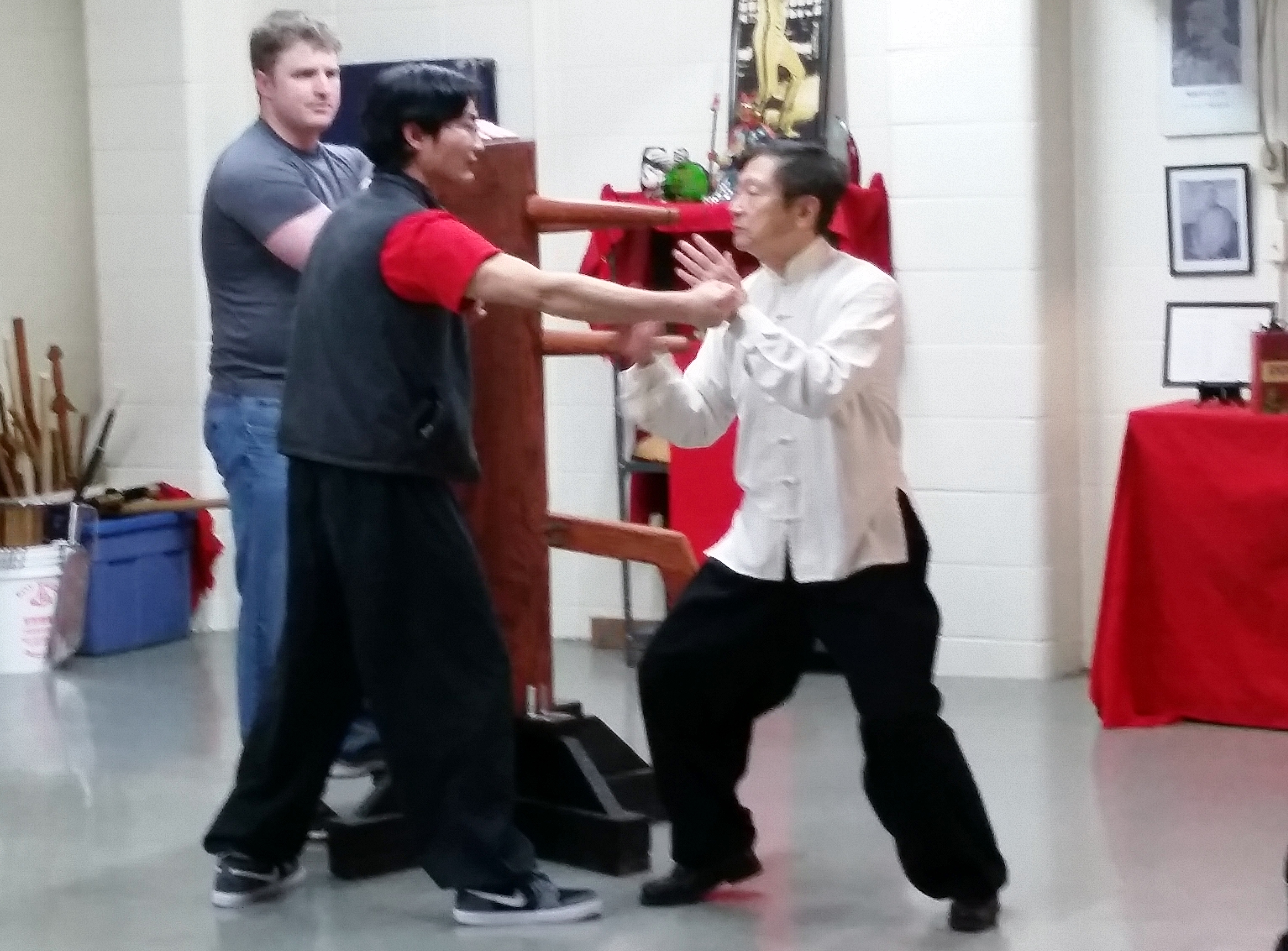
Sifu Leang giving a demonstration with students at the Chinese New Years potluck.
Sifu Leung giving a demonstration with students at the Chinese New Years potluck.

The first notable difference in Wing Chun vs. my more familiar styles is the stance. In Muay Thai I stand weak side forward with foot pointing straight and strong foot back pointing about 45 degrees. My hips are square but my body is slightly turned. I stay on my toes and my hands are in front of my face at all times possible. The basic Wing Chun boxing stance is with hips and shoulders square, feet about shoulder length apart with toes turned in (you look like you have bird legs which is fitting since Wing Chun came from the Crane Kung Fu style). You relax into your hips with back straight, not arched, and hips rolled down so your butt doesn’t stick out. You are more flat footed in the Wing Chun stance, you often lead with your strong side and often incorporate pivot motions (like your feet are wiper blades) while you punch or block to either side. So far my biggest challenge is figuring out when and how to step.

Hand position is the next major difference. I have always been taught to keep my hands in front of my face at all times. When I punch the opposite hand is tucked close for face protection and after the punch that hand comes right back to the face. Wing Chun focuses on a strategy of close quarter simultaneous attack and defense that often requires you to touch your opponent so you can feel where they are going next. To this end you keep your hands farther out in front of you. While throwing a punch with one hand the other is in a relaxed position at mid-forearm to elbow of the punching arm.

In general the Wing Chun movements are relaxed and subtle compared to the precise and powerful blows of Muay Thai, though no less effective depending on the situation. Some similarities of the styles that I have trouble with is keeping a strong center line and not leaning too far when dodging a punch. I also have trouble keeping my thumb wrapped around my fingers, a bad habit I hadn’t noticed before due to the wraps and gloves I wear in Muay Thai and Western Boxing. So far I am enjoying the lessons and look forward to expanding my fighting skills at Leung Martial Arts.
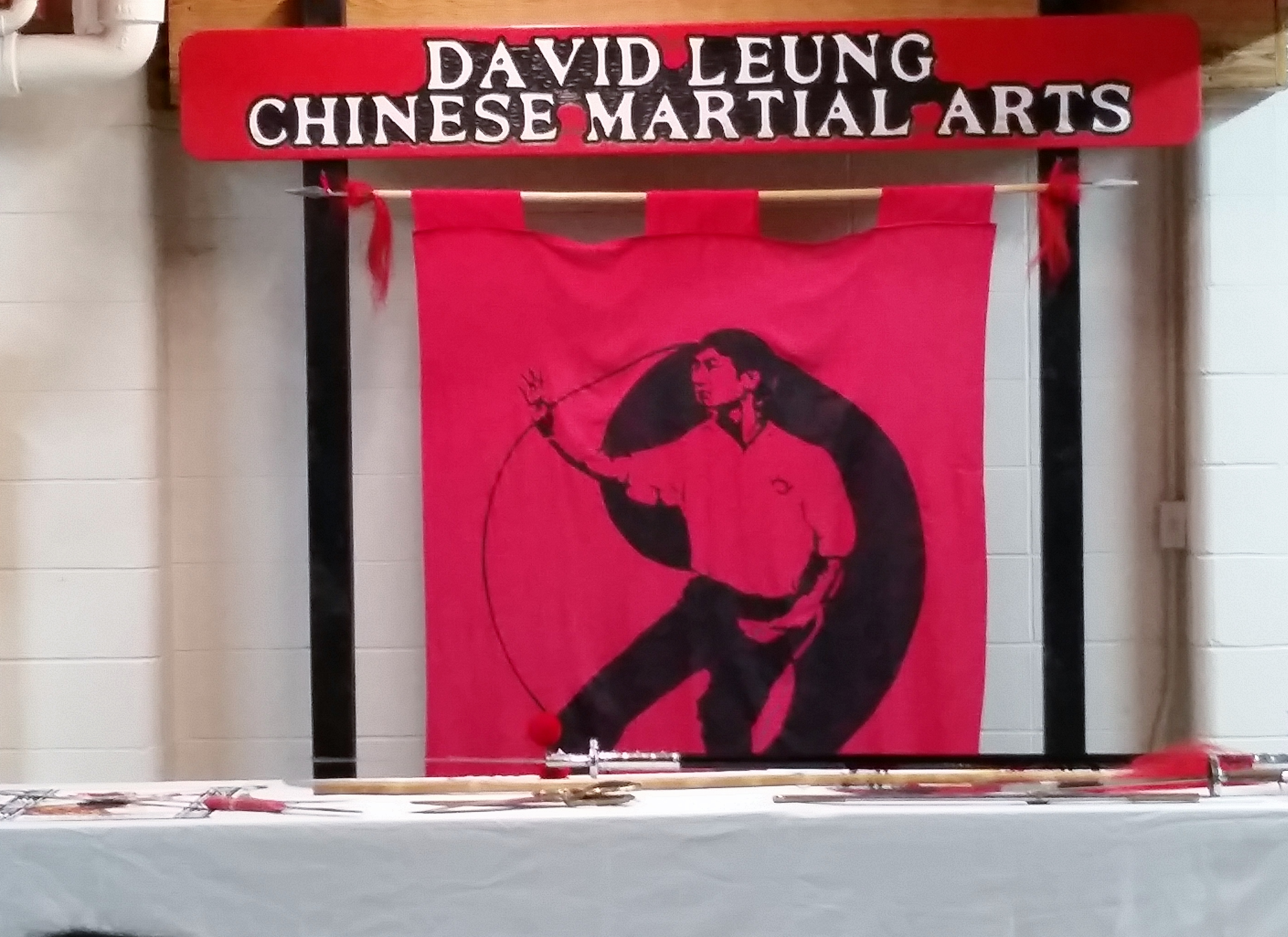
The school banner.
The school banner.

The Triangle Choke


All my life I have loved all forms of martial arts, I am a blue belt in Brazilian Jiu Jitsu and train in Muay Thai at an advanced level. I fully appreciate the idea of mixed martial arts and dabble in all kinds of disciplines. There is no doubt that several of my future blogs will have fighting/self-defense themes. Today, though, the topic is on one of my personal favorite submissions, the triangle choke.

For those unfamiliar with the triangle choke submission, or Sankaku-Jime as it is known in its parent discipline of Judo, is a type of figure-four chokehold. It strangles the opponent by encircling their neck and one arm with your legs in a configuration similar to that of a triangle. In essence the triangle choke turns you into a human vice that constricts blood flow from the carotid artery to the brain, forcing the opponent to pass out. It is a popular move used in modern MMA, Brazilian Jiu-Jitsu and Judo.

The man largely accredited for developing the triangle choke is Master Tsunetane Oda, the creator of Kosen Judo. Tsunetane Oda was born in 1892 in Yamanashi Ken Japan. He began practicing Judo at the age of seventeen in 1909, and by 1911 had already earned the title of 1st Dan. Traditional Judo often focuses on finishing an opponent by what is known as Nage Waza, or throw submissions, and there was less of an emphasis on Katame Waza, or ground grappling. Oda was of the opinion that Judo training should be 50% Nage Waza and 50% Katame Waza, since most all fights begin standing and end on the ground. He had a special emphasis on his ground game and, encouraged by his own teacher to research the subject, developed the basis for most Katame Waza in modern Judo. Tsunetane Oda died in 1955 and was fond of the philosophy “…while young Judoka can easily move like rabbits, older Judoka move like turtles, but can still survive using Katame Waza.”

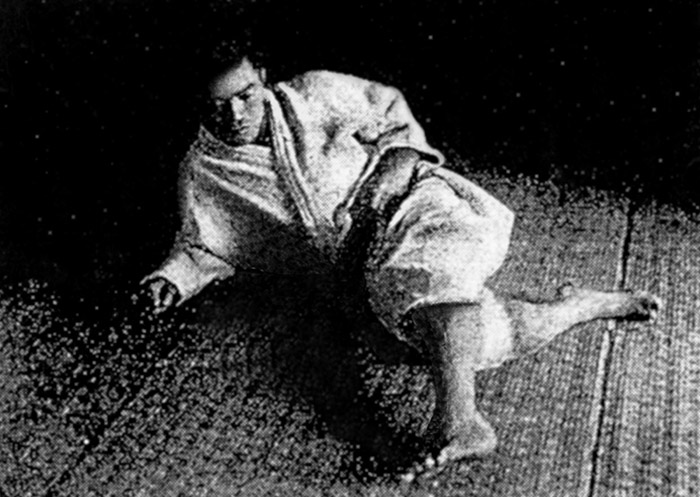
Master Tsunetane Oda (1892-1955) accredited for developing the triangle choke.
Master Tsunetane Oda (1892-1955) accredited for developing the triangle choke. 


Master Tsunetane Oda developed a series of the Sankaku-Jime triangle chokes in 1920 and they have only evolved from there. Following is a breakdown of the triangle choke I am most familiar with that can be achieved from closed or open guard.

Step 1: I have my opponent in my open guard. I isolate their left hand and drive their right hand back between my legs. (Can also be achieved by isolating right hand and driving the left between legs).

Step 2: Bracing my left foot on my opponent’s hip, I hip out to the right and rap my right leg around their neck.

Step 3: Holding my shin, I clinch my left knee around my right ankle, trapping my opponent’s neck and arm. I arch my back to isolate my opponent’s right arm across my chest.

Step 4: I squeeze my knees together, arch my back, and pull down on their head until my opponent submits. Note: Angle is important, I’m practically looking into my opponent’s ear while I finish the choke.

Triangle Choke
Triangle Choke


Some tips to defend against the triangle choke. First of all, don’t get put in it. If someone has you in their guard, either keep both of your elbows in, or both elbows out from between their legs. One arm out and one arm between your opponents legs sets you right up to be put in the triangle choke (see step 1).

If you do find yourself getting put in the choke, violently twist towards the arm they have isolated across their chest. If they haven’t yet quite locked in the hold, this will create more space that will allow you to sneak your opposite hand in by your ear, just a few fingers protecting the neck can relieve a tremendous amount of pressure on you artery. Then bear your weight down on your opponent to reduce their leverage, as you try to work your neck out.